Wednesday, November 24, 2010

C.S. Lewis is Lost and Found in Translation

"Aslan is on the move."

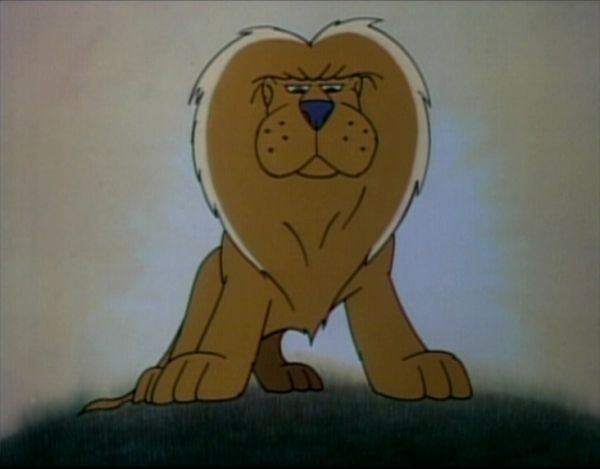
In 1950, C.S. Lewis's classic novel The Lion the Witch and the Wardrobe was published. Since then Lewis's book, a child's fantasy reimagining of the story of Jesus Christ, has inspired three film adaptations. Of these three films, the 1979 Children's Television Workshop made-for-T.V. cartoon production is my favorite and also my choice for comparative analysis.
The cartoon version of the film is not very well animated. It is not so much that the film's animation is bad, rather it is simply just not close to anything that could be called “visually impressive”. However, the mediocre animation quality does not stop the greatness of the story as well as it's intensely imagined characters form completely capturing your attention. Lewis wrote The Lion the Witch and the Wardrobe in a way that vividly described the characters as well as the geography of it's setting, the country of Narnia. Though the animation is not-so-great, the vividness of Lewis's world and its characters are clearly imagined on screen in 1979 film. This transference of richness can be clearly seen through the character of the reluctantly treacherous fawn, Mr. Tumnus. Upon meeting the human Lucy, Thumnas is shown speaking hushed-tone asides to himself while at the same time moving with humorous and inviting body language. Mr. Thumnus's deceitful nature is displayed to the viewer immediately through the differences in his verbal and body language. Though Lewis did not necessarily write Thumnus's introduction in this way, the film's added context feeds into greatening the books intended disposition for the Thumnus character. Though most of the cartoon adaptation flows quite closely to and in aid of the book's plot points, there are a few instances in the cartoon in which the slight drift from the Lewis original is not necessary best. For example, the scene in the 10th chapter where the children are given gifts (weapons to fight the forces of evil) by the one and only Father Christmas. In the cartoon Father Christmas never appears. His presence is mentioned, just as in the book, by the old dogfox to the White Which. In the cartoon the children still receive their gifts, but they are given to them by Alsan rather than Father Christmas. This alteration changes the entire essence of Narnia. In the book, Lewis uses Father Christmas to create a bridge between the realities of the human Earth and Narnia. "I've come at last," said he [Father Christmas]. "She has kept me out for a long time, but I have got in at last. Aslan is on the move. The Witch's magic is weakening." This bridge, created by Lewis, lost by the cartoon, is not necessary for support of the story's main points, but it helps the observer create a more vivid understanding of Narnia and its relationship to our world, thus bringing Narnia and its creatures further to life.
The cartoon adaptation of The Lion the Witch and the Wardrobe is a good adaptation. Though it leaves out parts of the story that are crucial to the greater understanding of the books genius, it is an adaptation that keeps true to most of the stories plot points and does so in a smartly expressive way.

Monday, November 8, 2010

Team Awesome gets Spirted Away

 When Team Aweosme got together outside of class to plan our presentation, we decided that the best way to get the class to actually participate was to break them up into small groups and go over specific "Spirted Away" related topics with them. Then after all the students had some facts, we would regroup as a class and discuss what we all had learned. This worked great in theory, though in practice I believe we overestimated their enthusiasm. However, I do feel that overall our presentation was a success.

 Joe's video clips and explanation of the Shinto religion were a great beginning. I had much enjoyed the "Return to Oz" group's explanation of the behind the scenes of the film and believe I did a great job conveying to the class the hard work I took to get Spirted Away made. After the small groups convened, I spoke first. I had planned on giving examples from my group discussion, but because only two of the five had seen the film we didn't come up with much. I feel like what I did give to the group was good, though I failed to deliver it as smoothly as I planed. I feel Jasmine, Nikole, and Joe did swimmingly in explaining their topics, and Dylan's insight rapped things quite nicely.

 If I had to do it all over aging, I don't think I would have wanted to break up into groups. I think instead I would have wanted to (assuming as we did that most of the class had not seen the film) show many short, well cued clips that corresponded with our individual points. Oh well, I had fun, liked the film we chose and my group members and would be more than willing to work with them again.

Thursday, October 28, 2010

The Better Oz

  The differences between L. Frank Baum’s book The Wonderful Wizard of Oz (1900) and MGM’s movie The Wizard of Oz (1939) are numerous. Typically, when an adapted movie differs form its originally story text it is a bad thing. With Oz however, this is not the case.

  Baum’s book is array with quirky lands, bothersome character encounters, and forgettable plot lines. There is no real evil to be vanquished and the books conclusion does not really make much sense. MGM’s film on the other hand uses a much more streamlined story, array with wonderful sets, fantastic songs, an evil-in-the-flesh Wicked Witch of the West, and an ending that gives the story context and brings it beautifully together.  

  In Baum’s book Dorothy and company face no real climax of action in their journey through Oz. The Wicked Witch of the West is vanquished half way through the book leaving no other looming threat to be dealt with. This lack of a real master evil makes Dorothy’s journey feel much less like and epic quest an much more like a string of misadventures, and thus leaves the reader feeling quite board. In addition, it is quit hard to believe that the dusty, grey, overwhelmingly dull Kansas of the book is a place Dorothy, or anyone for that matter, would want to return to. This lack of a relatable goal also leaves the reader feeling disconnected form the book and sets many into a “who cares” attitude.

  The MGM picture striped down Baum’s story to something everyone would love. It redirected the Wicked Witch of the West to be presented front and center as the wicked Miss Gulch before Dorothy even drops into Oz. With such a clear and present danger the audience is immediately captivated and keeps it that way as the Witch remains at Dorothy's heals throughout the film. Dorothy’s journey through the film Oz is also much more streamlined then in the book. The pointless stork river scene and the delicate China Country are removed, along with some other of the more drudging story points. Dorothy is also given additional and needed motivation to return home when she is shown a glimpse of Aunt Em crying for her missing niece.

  In addition to the main story changes, the small image conscious changes of the film are in good taste. The magical silver slippers of the book become ruby slippers in the film- a much more visually pleasing and eye popping color in the movies marvelous Technicolor. Another tasteful image change is that of the book’s short, fat, eye-patched Wicked Witch of the West into a tall and thin, toxic-green, hag. Not only does this change make the witch seem to be a more formidable opponent but it also does the films Technicolor more justice. Also, the casting of gorgeous 19 year old Judy Garland to play the books preteen Dorothy gave movie audiences one more visual to aid the films beauty. In addition to the visual changes, the addition of the musical numbers also greatly aid to the film’s spectacular fame. “Follow the Yellow Brick Road”, “Over the Rainbow” and “If I Only Had a Brain”, to name just a few, lend much help to not only drawing in the audience but also with moving along the storyline. The songs not only create a emotional cohesion between the audience and Oz’s characters but also between the characters themselves. 


  In conclusion whether you like it or not, L. Frank Baum’s haphazard book The Wonderful Wizard of Oz lead to the creation of one of the most beloved and well respected films ever made. Thanks frank.

Hot Judy Garland
 
Fabulous Technicolor

Wednesday, September 22, 2010

Alice in Manylands


   Lewis Carroll's Alice in Wonderland may not necessarily have been entirely written for a child audience, but believing otherwise requires no leap of faith. Jan Švankmajer's 1989 adaptation Alice, on the other hand, is so disturbing, offsetting, and dingy that the late great Johnny Cochran would have a hell of a time convincing anyone that the glove of the movie would fit any hand other than that of the most mature adult audiences. The film casts Wonderland in a decrepit and decaying Czech house. The dim lighting and cast of inanimate, dead, and otherwise disturbing creatures constantly plague Švankmajer's Alice to the point that any normal adult viewer becomes offset, both physically and emotionally. The death and dinge on screen are accompanied by an audio assault of repetitive mechanical suffering. Broken cogs and mistreated ratchets numb the viewers mind with paralytic viciousness. In all the feature was one of the most tortorius i have seen without haveing an obvious outright intention of being so.
   Walt Disney, a paradigm of morality and virtue, also created an adaptation of Carroll's Alice. Disney's adaptation of the book was obviously, easily arguably for a innocent audience. The Disney Wonderland was exactly that, a place of wonder. Set in a ubercolored, forest, dreamworld, Disney's Alice may have the misfortune of constantly encountering obstacles, but the vast and vibrant color scheme and melodic and upbeat soundtrack constantly reassure the viewer that everything will turn out okay. The Disney Alice is propelled through a world much closer to that of Carroll's creation. The creatures she encounter are close representations of the originals drawn by John Tenniel, anr though at times may present a threat to Alice, they are (for the most part) drawn in a manner not to impose much fear or unease in Alice or the viewer.
   When comparing the two films, it is easy to conclude that 's Jan Švankmajer's Alice is far more adult both in it's tone and  screen images than its Walt Disney counterpart. Though, that is not to say that adult orientation of the book is bad, Carroll did in fact write the story with many adult subtleties, it is just the opinion of this author that Wonderland should represent something I want to wonder about, and Švankmajer's world of Alice is not one of them.   

Wednesday, September 15, 2010